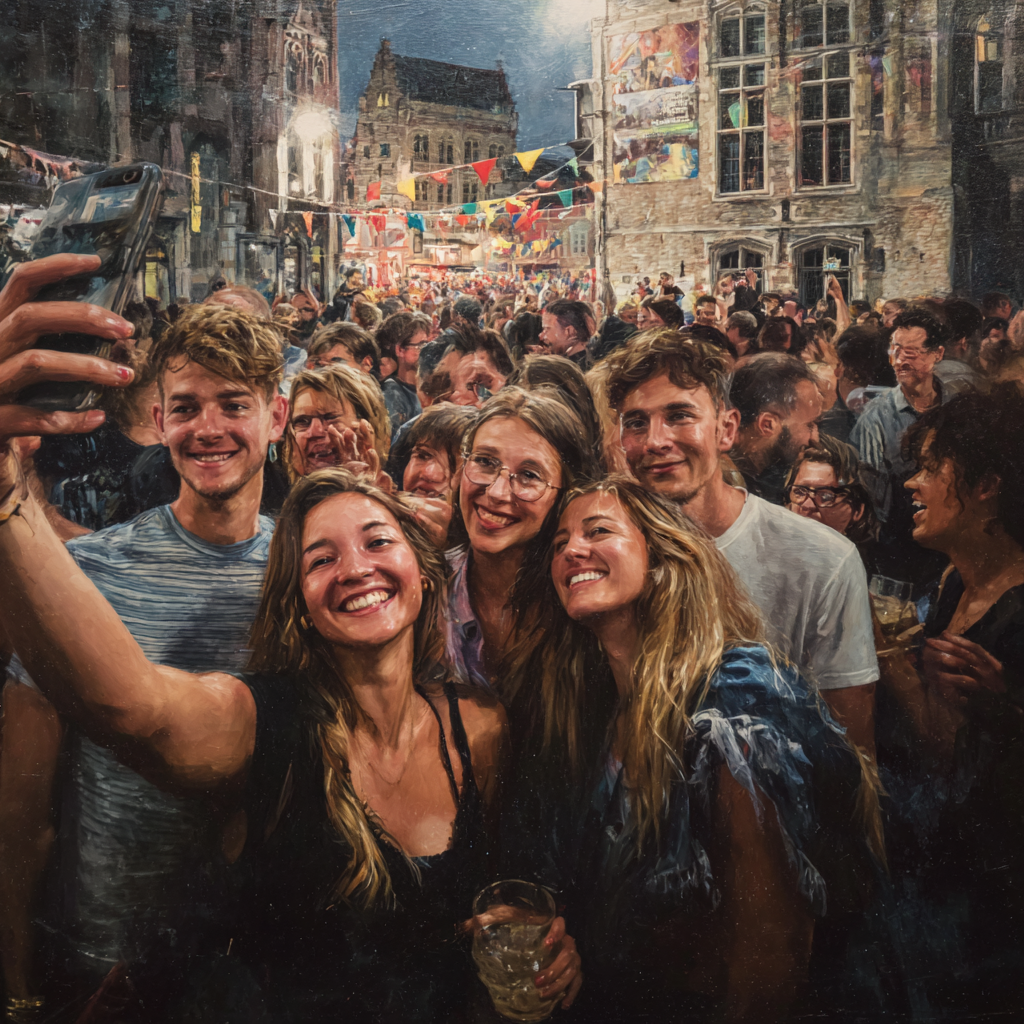
Ghent Festivities
For ten days in July, Ghent fills with stages, musicians and over 1.5 million visitors. The Ghent Festivities are the largest free street festival in Europe — one of Belgium’s most beloved summer traditions.
✅ Free admission — the Ghent Festival is completely free. Dozens of stages with performances across the city are open to everyone.
Free entry — the vast majority of the programme is completely free.
How it started
The festival grew from medieval city celebrations into an internationally recognised event. The Stroppendragers — referencing the punishment of rebellious Ghentians in 1540 — are the mascot of Ghent’s distinctive spirit.
What to expect
Over 300 programmed acts plus spontaneous performances everywhere. Stages on Korenmarkt, Sint-Baafsplaats, Vrijdagmarkt and dozens more. Programme ranges from world music and folk to electronic, jazz and classical.
With more than three hundred programmed acts and countless spontaneous performances on every street corner, the choice for visitors is almost overwhelming. Stages stand on the Korenmarkt, Sint-Baafsplein, the Vrijdagmarkt and dozens of other spots throughout the city, and the programme moves effortlessly between world music, folk, electronic music, jazz and classical. During the day there’s room for children’s activities, markets and guided tours; once evening falls, the city buzzes on into the early hours.
The Stroppendragers
The festival’s mascot, the Stroppendragers, refers to the noose Ghent’s rebellious citizens were forced to wear as punishment in 1540 — a symbol that’s since become shorthand for the stubborn, mildly rebellious spirit running through the whole festival.
Scale and informality
What sets Gentse Feesten apart from many other city festivals is its scale combined with its informality. This isn’t a tightly directed event with a strict schedule, but a ten-day celebration spread across the entire city centre, where visitors find their own way between the programmed stages and the spontaneous street music that pops up everywhere. The mood is exuberant without being chaotic, festive without feeling forced — typically Ghent, as locals like to call it themselves.
For the city itself, the festival is more than just a tourist draw. For ten days the entire centre goes car-free, and residents of all ages head out to run into neighbours, friends and strangers on squares that are ordinary traffic routes the rest of the year. For many families it’s become a fixed part of summer, complete with its own traditions: the same terrace every day, the same stage every evening, year after year.
Stay a little longer and you’ll discover that each part of the centre has its own “party district,” each with a slightly different crowd and musical offering, from cabaret and comedy to rock and electronic music. That division into districts makes Gentse Feesten less overwhelming than it looks — anyone after a quieter corner only has to walk a few streets. Many locals plan their schedules weeks ahead around the festival, which says something about how seriously the city takes it.
Gentse Feesten takes place in 2027 from 16 to 25 July in Ghent’s city centre, spread across multiple locations. Most performances are free; some indoor programmes use ticket sales. Ghent is reachable by train to Gent-Sint-Pieters station, followed by tram or about a twenty-minute walk — the city centre itself is car-free during the festival. Anyone planning to stay overnight should book well ahead, since Ghent becomes one of Belgium’s most popular destinations during the festival.
Practical info
- • Date 2027: 16–25 July
- • Entry: free (most events); some indoor programmes require tickets
- • Getting there: train to Gent-Sint-Pieters, then tram or 20 min walk; city centre is car-free during the festival
- • Tip: book accommodation well in advance — Ghent fills up completely