San Fermín Pamplona
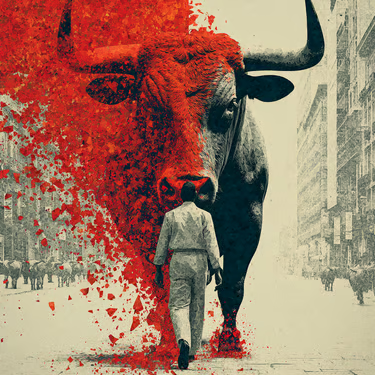
Every year from 6 to 14 July, the Spanish city of Pamplona erupts in one of the world’s most famous festivals: the Fiesta de San Fermín. Made internationally famous by Ernest Hemingway’s novel The Sun Also Rises, this nine-day celebration offers the legendary Running of the Bulls, spectacular fireworks, traditional music, dance and an atmosphere of pure infectious joy.
✅ Free admission — the Fiestas de San Fermín are completely free. The bull runs, processions and street parties are open to everyone.
Free entry — the bull run and most outdoor events are free.
A festival with centuries-old roots
The Festival of San Fermín has its origins in medieval celebrations of Pamplona’s patron saint. The Running of the Bulls (Encierro) — where participants run before six fighting bulls through narrow streets — originated in the practical necessity of moving bulls from their pens to the arena.
What makes San Fermín unique
The Chupinazo opens the festival on 6 July at noon — a rocket fired from the Town Hall balcony signals the start and the packed square explodes in celebration. Every morning from 7–14 July at 8:00, six fighting bulls run the 875-metre course through the streets. Beyond the bulls, San Fermín is a festival of music, dance, food and drink, with peñas (social clubs) playing music day and night throughout the city.
The Chupinazo and the daily bull run
The festival begins every year at exactly noon on 6 July with the Chupinazo: a rocket fired from the balcony of Pamplona’s town hall, the official starting signal for nine days of non-stop celebration. From that moment the whole city turns white and red, with thousands of visitors in the traditional outfit of white clothing and a red scarf around the neck.
The highlight of every morning is the encierro, the famous bull run, which takes place each day at eight o’clock through the narrow streets of the old town to the arena. Runners sprint ahead of a group of bulls over a route several hundred metres long — a tradition that’s become world-famous and remains genuinely dangerous. Anyone running does so entirely at their own risk and should follow the official safety guidelines at all times; anyone who’d rather watch can find plenty of spots along the route and on the balconies of surrounding houses to experience the spectacle from a safe distance.
Parades, music and fireworks
Outside the morning bull run, there’s just as much happening the rest of the day. Parades with giant puppets move through the streets, music groups and dancers keep an unbroken party atmosphere going across the city, and in the evening fireworks colour the sky over Pamplona. The mood is exuberant and infectious: this is a celebration where spectator and participant are barely distinguishable, and where the whole city gives itself over, day and night, for nine days, to a tradition held for centuries.
Anyone who wants to experience the encierro up close without running should look for a spot along the route or book a place on one of the balconies overlooking the narrow streets — by far the safest way to experience the spectacle. Outside the early morning hours, the festival revolves mainly around the squares of the old town, where music, dancing and sangria take turns day and night until the final fireworks show closes the festival on 14 July.
Practical info
- • Date: 6–14 July, annually in Pamplona, Spain
- • Entry: bull run and outdoor events free; bullfights are paid
- • Dress code: traditional white clothing with red scarf
- • Safety: the bull run is dangerous — always follow official safety guidelines